Best Time to Visit Darjeeling: Views, Tea and the Toy Train by Month
Darjeeling is open all year. What changes month to month is whether Kanchenjunga shows itself at Tiger Hill, which tea is being picked, how the roads up from Siliguri are holding, and how many people from Kolkata had the same idea.
The best time to visit Darjeeling is mid-October to mid-December if you want the view of Kanchenjunga, and March to May if you want mild weather and the tea gardens at work. In autumn the monsoon has scrubbed the air, and on most mornings the whole Kanchenjunga range turns pink from Tiger Hill and stays visible from the Chowrasta for a few hours. In spring the first flush is being plucked, rhododendrons and magnolias bloom on the ridges, and the town escapes the heat of the plains. December and January are cold, clear and quiet, except for the Christmas week. June to September is the time to avoid: cloud hides the mountains for weeks and landslides cut the roads from Siliguri.
Darjeeling sits on a single ridge at about 2,050 m, so its weather is simpler than Sikkim's. There are no high passes to close, no permits to wait for and very rarely snow in town. What matters is visibility, rain on the roads and crowds. This guide takes the year month by month, then explains the tea seasons, the toy train, Tiger Hill and the monsoon roads, and ends with verdicts by traveller type. Dates and fares that change are checked as of November 2026. If you are combining Darjeeling with Gangtok and North Sikkim, read our best time to visit Sikkim guide as well; the snow and permit questions are covered there.
Updated November 2026 by the Vibrant Holidays team, Ahmedabad.
Holiday packages for the places in this guide
Our latest matching packages on Vibrant Holidays — 2 to 15 nights. Every package can be customised for departure from your city.
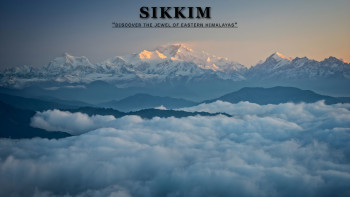

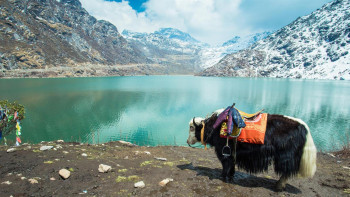
Darjeeling month by month: the quick verdict
Darjeeling town day high / night low in °C, rounded long-term averages. Tiger Hill at sunrise is 3–5 degrees colder; Siliguri and Bagdogra in the plains are 12–15 degrees warmer.
| Month | °C | Kanchenjunga | Tea gardens | Toy train and roads | Crowds | Verdict |
|---|---|---|---|---|---|---|
| January | 9 / 3 | Very likely on clear mornings | Dormant; factories mostly shut | Joyrides run; roads dry | Low | Good for views, cold rooms |
| February | 11 / 4 | Likely, haze rising late | Pruned bushes; some factories prepare | Normal | Low | Good and cheap; Losar at Ghum |
| March | 15 / 7 | Fair, often hazy after 9 am | First flush starts | Normal | Rising after Holi | Good for tea lovers |
| April | 18 / 10 | Fair at dawn | First flush at its best | Normal; pre-monsoon storms | Moderate to high | Very good; rhododendrons |
| May | 19 / 12 | Patchy | Second flush begins late May | Busy joyrides | High (summer vacation) | Good, book ahead |
| June | 19 / 14 | Rare | Second flush | Monsoon arrives; first slides | High early, then falling | First half only |
| July | 19 / 15 | Almost never | Monsoon flush | Landslides on all routes up | Low | Avoid |
| August | 20 / 15 | Almost never | Monsoon flush | Closures and diversions common | Low | Avoid |
| September | 19 / 14 | Clearing late in the month | Monsoon flush ends | Rain easing | Low, rising late | Last week only, with slack |
| October | 18 / 11 | Good, improving through the month | Autumn flush | Extra Puja joyrides | Very high in Puja week | Excellent outside Puja week |
| November | 15 / 7 | Best of the year | Autumn flush ends | Normal | High around Kali Puja, then moderate | Excellent |
| December | 12 / 4 | Excellent | Plucking stops | Normal; Christmas rush | Moderate, very high 24 Dec–1 Jan | Very good; cold nights |
A clear month is not a promise of a clear morning. Even in November one day in four or five can be cloudy at dawn, which is why we put Tiger Hill on the second or third morning of a stay and keep one morning in reserve.
When can you see Kanchenjunga from Darjeeling?
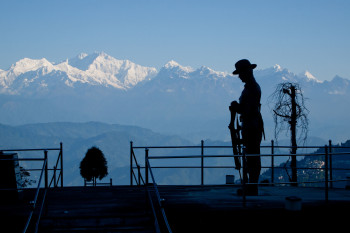
Kanchenjunga, at 8,586 m the world's third-highest mountain, lies about 75 km north-west of Darjeeling. Whether you see it depends on two things: monsoon cloud and dry-season haze.
- October to January is the window. The rain has washed dust out of the air, there is little cloud, and the range is often visible all morning from the Mall, Observatory Hill and the road to Ghum. November and December are the most reliable months of the year.
- February and March start clear but haze builds by mid-morning, partly from dust and partly from forest and field fires in the foothills. Get to a viewpoint by sunrise.
- April and May give a view at dawn on some days, then the mountain disappears into afternoon cloud. Spring is for tea and flowers, not for mountain photography.
- June to September: expect to see Kanchenjunga on very few days, if any. Late September sometimes produces a sudden clear morning after rain.
Tiger Hill sunrise by season
Tiger Hill (about 2,590 m), 11 km from town above Ghum, is where the first light hits Kanchenjunga before the hills below it. Jeeps leave town in the dark, and the time you set the alarm changes a lot through the year.
| Season | Sunrise, roughly | Leave Darjeeling by | What to expect |
|---|---|---|---|
| November to January | About 6 to 6.15 am | About 4.30 to 5 am | Best chance of the full range, often with Everest's tip far to the west; bitterly cold wind |
| October, February | About 5.30 to 6 am | About 4 to 4.30 am | Good chance; Puja week brings long jeep queues |
| March to May | About 5 to 5.30 am | About 3.30 to 4 am | Dawn view on some days, haze after |
| June to September | About 4.45 to 5.15 am | Usually not worth going | Mostly cloud |
The open ground at the top is free; the covered upper viewing gallery charges a small fee, around ₹40–50 as of November 2026. On busy days the last kilometre jams with jeeps, so drivers set out earlier still. For seniors we often skip the pre-dawn trip and watch the range from a hotel room facing north instead, which in November can be nearly as good.
Darjeeling tea seasons: which flush when
Darjeeling tea is plucked in "flushes", bursts of new leaf that each produce a different taste. If tea is part of the reason for your trip, the month decides what you will see in the gardens and what you will drink at the estate.
| Flush | Usual months | In the cup | Visiting the gardens |
|---|---|---|---|
| First flush | Mid-March to April | Light, floral, almost green; the most prized and costliest | The best time to watch plucking and processing; factories busy |
| Second flush | May to June | Fuller, the famous "muscatel" flavour, darker liquor | Good; factories busy, afternoons may be wet from June |
| Monsoon flush | July to September | Strong, mostly for blends and everyday tea | Gardens lush but paths muddy; factory visits depend on the estate |
| Autumn flush | October to November | Mellow, coppery, smooth | Pleasant weather and views at the same time; the best all-rounder |
| Dormant season | December to February | No plucking | Bushes pruned; many factories closed for maintenance, so ask before driving out |
Exact dates shift with the rain: a dry winter delays the first flush, an early monsoon brings the second flush to a quick end. Estates close to town, such as Happy Valley, and the gardens along the road to Kurseong and Mirik are the easiest to visit; some heritage estates also take overnight guests in their old bungalows, which suits couples on a slower trip. Buy first flush in April for the freshest leaf; in winter you will be buying last year's crop.
The toy train through the year
The Darjeeling Himalayan Railway, a UNESCO World Heritage site, still runs its narrow-gauge trains through the middle of town. Most visitors take the joyride: Darjeeling to Ghum and back, about two hours, with a halt at the Batasia Loop where the line spirals around a war memorial with the mountains behind it. Steam-hauled rides cost about ₹1,500 and diesel ones about ₹1,200 per person as of November 2026; booking opens on IRCTC well in advance, and peak-season steam seats go fast.
- October to December and March to May are the best months to ride: clear views from Batasia and dry tracks. In Puja season the railway adds extra services; for October 2026 it announced additional Darjeeling–Ghum joyrides and Kurseong–Mahanadi round trips with steam and diesel options.
- December to February: the ride is cold but quiet, and the steam smoke stands out against a clear blue sky, the best photographs of the year.
- June to September: services can be suspended after landslides on the line. After the October 2025 rains the railway stopped its trains for a period; it is the first thing to be cut and among the last to return.
- The full run from New Jalpaiguri to Darjeeling takes about seven to eight hours for 88 km. It is a railway enthusiast's day, not a transfer; most families drive up and take the joyride instead.
Book the joyride for your second day, never the day of arrival, because the drive up can run late. In the Puja and Christmas weeks we book as soon as your trip is confirmed.
Monsoon and the roads up from Siliguri
The weather in Darjeeling town is rarely dangerous. The roads that bring you up from Bagdogra and New Jalpaiguri are what make the monsoon a bad time. There are four main ways up, and in the rains each fails in its own way.
| Route | Time from Siliguri, dry season | Monsoon behaviour |
|---|---|---|
| Rohini Road to Kurseong, then Hill Cart Road | About 2½ to 3 hours | The quickest and most used; prone to slips on the steep Rohini section |
| Pankhabari Road to Kurseong | About 3 hours | Narrow and very steep; used as a diversion, not ideal for nervous travellers |
| Hill Cart Road (NH110) via Tindharia | About 3 to 3½ hours | Follows the toy-train line; long-running slide zones at points like Paglajhora |
| Mirik route via Dudhia | About 3½ hours | Scenic, with the Mirik lake on the way; depends on the Balason river crossing at Dudhia |
What a bad monsoon looks like: on 4 and 5 October 2025, about 261 mm of rain fell on Darjeeling in a single day. At least 28 people died across the district, a section of Rohini Road caved in, the iron Dudhia bridge on the Siliguri–Mirik road collapsed, NH10 towards Kalimpong and Sikkim was shut and the toy train stopped running. An alternative bridge at Dudhia opened about three weeks later. That storm came in early October, right in the Puja holidays, which is a reminder that the first fortnight of October still carries some monsoon risk.
For travel between June and early October we build in a free afternoon, avoid same-day flights out of Bagdogra after a hill drive, and let the driver choose the route on the day. Darjeeling to Kalimpong and Gangtok uses NH10 along the Teesta, which is the road most often shut in the rains.
Puja, Christmas and the holiday calendar
Darjeeling's crowds follow Bengal's calendar more than any other. Kolkata is an overnight train or a short flight away, and the Puja holidays empty the city towards the hills.
- Durga Puja (Vijaya Dashami fell on 20 October in 2026 and is expected around 9 October in 2027): from the Puja week until Kali Puja and Diwali (8 November in 2026, 29 October in 2027), Darjeeling is at its fullest. Hotels on the Mall, Tiger Hill jeeps and toy train seats sell out; book two to three months ahead. Travellers starting in Kolkata will find the flight and train choices on our Sikkim and Darjeeling from Kolkata page.
- Mid-November to mid-December: the sweet spot. Puja visitors have gone, the sky is at its clearest and hotel rates ease.
- Christmas to New Year: the Mall, the Chowrasta and the old churches are busy and festive; rates rise from about 22 December. Book early for 24 December to 1 January.
- Losar (Tibetan New Year, about 7 February in 2027): prayers and masked dances at Ghum and other monasteries; a good reason for a quiet February visit.
- Summer vacation (mid-May to mid-June): families from Bengal, Gujarat and Maharashtra escape the heat; a busy, warm, slightly hazy time.
We found no fixed-date Darjeeling carnival or tea festival announced for 2026–27 as of November 2026. Local winter events are sometimes held in December, but dates are set at short notice, so we never plan a trip around them.
Best time to visit Darjeeling for couples, families, seniors and trekkers
| Traveller | Best months | Why | Think twice about |
|---|---|---|---|
| Honeymoon couples | Mid-November to mid-December; February | Clear views, quiet cafés, a tea-estate bungalow for two nights | Puja week and Christmas week |
| Families with children | April to early June; late October to November | Toy train, the zoo and the Himalayan Mountaineering Institute on dry days; mild nights | Bengal school holidays, when everything is booked |
| Parents above 60 | March to April; November | Comfortable temperatures, dry roads, fewer steep detours | January nights in hotels without heating; monsoon drives |
| Tea lovers | April (first flush); late October (autumn flush) | Gardens and factories at work | December to February, when plucking stops |
| Photographers | November to January | Clearest air, Kanchenjunga from town, steam smoke on the toy train | Spring haze |
| Sandakphu trekkers | October to early December; March to May | Views of four of the world's five highest peaks from the Singalila ridge; spring rhododendrons | Mid-June to mid-September, when Singalila is usually closed to trekkers |
| Snow hopefuls | January to February | Occasional snow at Tiger Hill and Sandakphu | Expecting snow in Darjeeling town, which is rare |
| Budget travellers | February to March; late November to mid-December | Lower rates without the monsoon risk | Cheap monsoon deals that come with closed roads |
If snow matters, Darjeeling alone is the wrong choice; combine it with Gangtok and Tsomgo Lake in January or February. Darjeeling is a better fit for travellers who want views, tea, the old hill-station streets and a gentle pace.
What to pack for Darjeeling in each season
- December to February: thermals, a heavy jacket, woollen cap, gloves and warm socks. Many older hotels have only room heaters, and Tiger Hill at dawn can feel below zero in the wind.
- March to May: a fleece or light jacket, layers for cool evenings, a compact umbrella for pre-monsoon storms in late April and May.
- June to September: rain jacket, quick-dry clothes, shoes with grip for the steep lanes, and medicine for winding roads.
- October to November: a warm jacket for evenings and Tiger Hill, sunglasses and sunscreen for the bright high-altitude light.
In every season bring comfortable walking shoes. Darjeeling is built on slopes, cars are not allowed on parts of the Mall, and the walk from many hotels to the Chowrasta is steep. Carry some cash for jeep stands and small tea shops, though UPI works in most of town.
How we plan a Darjeeling trip around the season
- View-first trip: mid-October to January, three nights in Darjeeling so that one of two Tiger Hill mornings is clear, then Gangtok or Pelling.
- Tea-first trip: April or late October, two nights in town and one or two on a tea estate near Kurseong or Mirik.
- Family summer trip: mid-May to early June, booked by February, with the toy train and zoo on separate days.
- Monsoon: only a short, flexible trip, with an extra day before the flight out of Bagdogra.
- Private and customised: your own car and driver from Bagdogra or New Jalpaiguri, your own dates; extended families travel as a private group on their own schedule.
- Season-aware plans: toy train booked when the trip is confirmed, Tiger Hill placed with a spare morning, route up chosen on the day in the rains.
- Vegetarian and Jain meals requested in writing; easy on the Mall, simpler on tea estates.
- 11 years of planning holidays from our C G Road office in Ahmedabad, booked on WhatsApp or phone, with 24×7 support on tour. IATA-accredited; member of TAAI, TAFI, ADTOI and IATO; recognised by the Ministry of Tourism, Government of India.
Ready itineraries with live prices are on our North East tour packages page. Flying from the capital, see Sikkim and Darjeeling from Delhi; for another hill escape in the same season, read the best time to visit Meghalaya, or browse all our holiday guides.
Plan your trip with Vibrant Holidays
Tell us your dates, budget and who is travelling. We reply with a day-wise plan and a clear price, usually the same day.
Get a Free Quote WhatsApp 9089090790Best Time to Visit Darjeeling: FAQs
Which is the best month to visit Darjeeling?
November is the best single month: the clearest skies of the year, Kanchenjunga visible from town on most mornings, the autumn tea flush finishing and the Puja crowds gone after Kali Puja. Late October and the first half of December are almost as good. For mild weather and first-flush tea, choose April.
When is Kanchenjunga visible from Darjeeling?
Most reliably from October to January, when the air is clean after the monsoon. February and March give clear dawns but hazy late mornings, April and May show the range only early on some days, and from June to September it is hidden on almost every day. Plan two sunrise chances in any season.
Is it worth visiting Darjeeling in the monsoon?
Only for a short, flexible trip. Rain itself is manageable in town, but views are rare and landslides close the roads from Siliguri. In early October 2025, extreme rain caused deadly landslides, cut Rohini Road and the Mirik route and stopped the toy train. Keep a spare day before your flight from Bagdogra.
Does it snow in Darjeeling?
Rarely in town. Light snow falls at Tiger Hill and on the Sandakphu ridge in some winters, usually in January or February, but you cannot plan a trip on it. For dependable snow, combine Darjeeling with Gangtok and Tsomgo Lake between late December and March.
What is the best time to see the tea gardens?
April, during the first flush, when plucking and processing are at their busiest, or late October during the autumn flush, when you also get clear mountain views. May and June are good for the second flush. From December to February the bushes are pruned and many factories are closed, so a garden visit then is mostly scenery.
When does the Darjeeling toy train run?
Joyrides between Darjeeling and Ghum run through the year, about two hours with a halt at the Batasia Loop. As of November 2026 steam rides cost about 1,500 rupees and diesel about 1,200 per person. Services can be suspended after monsoon landslides, and extra trains are added in Puja season. Book early for October and Christmas.
What time should we leave for Tiger Hill?
It depends on the month. In November to January sunrise is around 6 am, so jeeps leave town around 4.30 to 5 am. In spring sunrise is nearer 5 am, so leave by about 4 am. In Puja and Christmas weeks leave earlier, because the last stretch jams with vehicles.
Is Darjeeling crowded during Durga Puja?
Yes, it is the busiest time of the year. Visitors from Kolkata and the rest of Bengal fill the town from the Puja week through Kali Puja and Diwali. Book hotels, toy train seats and the Tiger Hill jeep two to three months ahead, or come from mid-November, when the weather is just as good.
Is December a good time to visit Darjeeling?
Yes. Skies are clear, Kanchenjunga views are excellent and the town is quiet until Christmas. Nights fall to about 3 to 5 degrees, so choose a hotel with heating and pack proper woollens. Christmas to New Year is festive and busy on the Mall, with higher rates from around 22 December.
How is Darjeeling different from Sikkim in timing?
Darjeeling has no high passes, no permits and rarely snow, so its timing turns on views, tea and road conditions. Sikkim adds snow at Tsomgo and Nathu La and permits for North Sikkim, which change with weather. Most travellers combine both between October and May.
How many days are enough for Darjeeling?
Two full days in town covers Tiger Hill, the toy train, the zoo, a tea garden and the Mall. Three nights is better, because it gives two chances at a clear Tiger Hill sunrise. Add two nights for a tea estate, Mirik or Kalimpong, and more if you combine Gangtok and Pelling.
