Best Time to Visit Bhutan: Season by Season, for Indian Travellers
Bhutan is open all year, but the same week can mean rhododendrons on the passes, a masked-dance festival in a dzong courtyard or a Paro flight waiting for the cloud to lift. Here is what each month brings and how it changes the trip from India.
The best time to visit Bhutan is March to May and October to November. Spring brings rhododendrons and magnolias on the high passes, mild days in Thimphu and Paro, and the Paro Tshechu festival. Autumn has the clearest air of the year after the monsoon, the Himalayan peaks are visible from Dochula on most mornings, and the Thimphu Tshechu fills the capital in early October. December to February is the quiet, good-value season: cold nights, sharp blue skies, and the black-necked cranes wintering in the Phobjikha valley. The months to treat with care are June to August, when monsoon rain brings landslides on the road from Phuentsholing and low cloud delays flights into Paro.
For Indian travellers, the season matters in a few ways that general guides skip. It decides whether the cheaper road route through Jaigaon and Phuentsholing is sensible or whether flying into Paro is worth the higher fare. It decides how hard it is to find rooms in festival weeks, when the Sustainable Development Fee you pay for each night buys less time outdoors. And Indian school breaks, Diwali and Christmas fill Bhutan's certified hotels at the same time as the international festival crowd. This guide goes month by month, then valley by valley, then by traveller type, with festival dates and entry rules checked as of November 2026. If you already know when you are going and want costs and routes, our Bhutan tour packages from Delhi and Bhutan tour packages from Kolkata pages cover those.
Updated November 2026 by the Vibrant Holidays team, Ahmedabad.
Holiday packages for the places in this guide
All 12 matching packages on Vibrant Holidays — 3 to 7 nights. Every package can be customised for departure from your city.
Bhutan month by month: weather, festivals and verdict
Day high / night low in °C, rounded long-term averages. Paro is close to Thimphu; Punakha, about 1,000 m lower, is much warmer; Phobjikha and Bumthang are colder than Thimphu.
| Month | Thimphu °C | Punakha °C | Rain and roads | Festivals and events | Crowds and rates | Verdict |
|---|---|---|---|---|---|---|
| January | 12 / -3 | 16 / 4 | Dry; snow can close Dochula or Chele La for hours | Cranes at Phobjikha | Low; best rates | Good for clear views and quiet monuments |
| February | 14 / 0 | 18 / 7 | Dry; occasional snow on passes | Punakha Drubchen and Tshechu 13–18 Feb 2027; Losar | Low, busy in Punakha festival week | Very good, especially Punakha |
| March | 17 / 4 | 22 / 10 | Mostly dry; haze builds late in the month | Paro Tshechu 18–22 Mar 2027; rhododendrons begin | High in Paro festival week | Excellent; book festival week early |
| April | 20 / 7 | 26 / 13 | Occasional afternoon showers | Rhododendrons at Dochula and Chele La; Haa spring festival | Moderate to high | Excellent for flowers and walks |
| May | 23 / 12 | 29 / 17 | Pre-monsoon showers increase late in the month | Indian summer holidays begin | High (Indian families) | Very good first half |
| June | 24 / 14 | 31 / 20 | Monsoon arrives mid to late June | Smaller temple festivals in Bumthang | Moderate, falling | Early June only; fly in |
| July | 25 / 15 | 32 / 22 | Wettest; landslides on border roads; Paro flights delayed | Few events; quietest month | Low; lowest rates | Avoid for a first visit |
| August | 25 / 15 | 31 / 21 | Heavy rain continues | Green valleys, leeches on trails | Low | Avoid for the road route |
| September | 23 / 13 | 30 / 19 | Rain easing; slides still possible in the first half | Paddy turns gold in Punakha late in the month | Rising | Good in the second half |
| October | 22 / 10 | 28 / 16 | Dry; clearest skies begin | Thimphu Tshechu 10–12 Oct 2027; Wangdue and Gangtey festivals | Highest of the year | Excellent; plan two to three months ahead |
| November | 18 / 4 | 23 / 11 | Dry and crisp | Crane festival 11 Nov 2027; Jakar and Jambay Lhakhang in Bumthang | High, Diwali week busiest | Excellent; best mountain views |
| December | 14 / -1 | 18 / 6 | Dry; first snow on high passes | Dochula Druk Wangyel festival 13 Dec; Trongsa Tshechu | Moderate; high over Christmas | Very good; cold mornings |
Festival dates follow the Bhutanese lunar calendar. The 2027 dates above come from the tentative schedule published by the Association of Bhutanese Tour Operators as of November 2026; they can move by a day or two, so we reconfirm before you book flights around one.
The four seasons in Bhutan
Spring: March to May
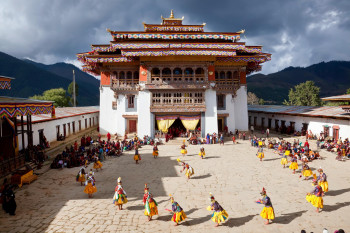
The season most visitors picture. Red and pink rhododendrons cover the forest at Dochula, Chele La and Pele La from late March to early May, and Punakha's valley floor is green with young paddy. Days are warm enough to walk without a heavy jacket, which makes it the easiest time for the climb to Tiger's Nest. The trade-off is haze: by April, distant peaks are often hidden by afternoon cloud, so a spring trip is about flowers, festivals and walking rather than long mountain views. Paro Tshechu in March is the most photographed festival in the country and fills Paro hotels months ahead.
Monsoon: June to August
Bhutan gets most of its rain in these months, heaviest on the southern foothills where the road from Phuentsholing climbs. Landslides are routine along that road and on stretches between Thimphu and Punakha, and they can hold traffic for hours. Paro airport handles flights in daylight and by sight, so low cloud can delay or turn back a morning flight. The valleys are beautiful and empty, rates are at their lowest, and short trips that fly in and stay in Paro and Thimphu can work. We do not plan the road route or long east-west drives in July and August.
Autumn: September to November
From the second half of September the rain clears and the sky turns a deep blue. October and November have the best chance of seeing Gangkar Puensum and the Masagang range from Dochula, of clear views of Jomolhari from Chele La, and of dry trails. It is also when the biggest dzong festivals happen: Thimphu, Wangdue and Gangtey in October, and the Bumthang festivals and the crane festival in November. These are the busiest weeks of the year for Bhutan's hotels and flights.
Winter: December to February
Cold and bright. Thimphu and Paro drop below freezing at night, while Punakha stays mild enough for lunch outdoors. Skies are mostly clear, rates are lower, and the monuments are quiet. Black-necked cranes winter in Phobjikha, and Punakha's festivals arrive in February. The risk is snow: a heavy fall can close Dochula on the Thimphu–Punakha road or block Chele La between Paro and Haa for hours or a day, as in December 2018, when both passes were shut by snow. Hotels need proper room heating, so we choose them with that in mind.
Paro, Thimphu, Punakha, Phobjikha, Haa and Bumthang: when each is best
| Valley | Height | Best months | What changes through the year |
|---|---|---|---|
| Paro (Tiger's Nest, Rinpung Dzong) | About 2,200 m | March to May; October to December | Tshechu in March; trail muddy in the monsoon; frost on winter mornings |
| Thimphu | About 2,320 m | All year except July–August | Tshechu in late September or October; weekend market every Friday to Sunday |
| Dochula pass | About 3,100 m | October to January for views; April for flowers | Snow can close it in winter; cloud often hides peaks in spring and the monsoon |
| Punakha and Wangdue | About 1,250 m | November to April | Warmest valley; hot and humid in July; jacaranda blooms around the dzong in spring |
| Phobjikha (Gangtey) | About 2,900 m | Late October to February for cranes; April to May | Cranes arrive from October, crane festival on 11 November, leave by about February |
| Haa valley via Chele La | About 2,700 m (pass about 3,990 m) | April to June; September to November | Chele La can be blocked by snow in winter; spring festival in late April |
| Bumthang | About 2,600 m and up | October to November; March to May | Jakar and Jambay Lhakhang festivals in November; long drive from Punakha |
Why Punakha is the winter valley
Punakha sits about a thousand metres below Thimphu, so a January afternoon there feels like a mild spring day while Thimphu is close to freezing. If you travel between December and February, give Punakha two nights instead of one, keep the Dochula crossing for the middle of the day when any ice has cleared, and save the Tiger's Nest climb for a sunny Paro morning. The Punakha Drubchen, with its re-enactment of a 17th-century battle, and the Tshechu that follows it, make mid-February a strong choice for anyone who wants a festival without the Paro crowds.
Bhutan festival calendar, late 2026 and 2027
Tentative dates from the tour operators' association schedule, as of November 2026. A Tshechu is a festival of masked dances in a dzong or temple courtyard; it is a religious event, so dress modestly and follow your guide on photography.
| Festival | Where | Dates | Worth knowing |
|---|---|---|---|
| Jambay Lhakhang Singye Cham | Bumthang | 24 November 2026 | Far east of the usual circuit; needs a longer trip |
| Druk Wangyel Tshechu | Dochula pass | 13 December 2026 and 13 December 2027 | Performed by the army in the open air with the Himalaya behind on a clear day |
| Trongsa Tshechu | Trongsa | 17–21 December 2026 | Central Bhutan; suits a Bumthang trip |
| Punakha Drubchen and Tshechu | Punakha Dzong | 13–15 and 16–18 February 2027 | Mild weather, fewer crowds than Paro |
| Paro Tshechu | Rinpung Dzong, Paro | 18–22 March 2027 | The giant thangka is shown at dawn on the last day; Paro rooms sell out first |
| Haa spring festival | Haa valley | About 25–27 April 2027 | District event; dates confirmed closer to the time |
| Wangdue Tshechu | Wangdue Phodrang | 8–10 October 2027 | Combine with Punakha |
| Thimphu Tshechu | Tashichho Dzong, Thimphu | 10–12 October 2027 | The biggest crowd of the year; stay in Paro and visit for a day if Thimphu is full |
| Gangtey Tshechu | Gangtey monastery, Phobjikha | 13–15 October 2027 | Small and atmospheric; just before the cranes arrive in numbers |
| Jakar Tshechu and Jambay Lhakhang Drup | Bumthang | 6–9 and 14–17 November 2027 | Includes a night fire ceremony at Jambay Lhakhang |
| Black-necked Crane Festival | Gangtey, Phobjikha | 11 November 2027 | Children's dances celebrating the cranes; a one-day event |
Two practical points. Festival weeks raise demand, not the SDF, so the fee you pay per night stays the same while hotel and flight prices rise. And a festival is usually one or two days of a trip, so we place it in the middle of the plan and keep the rest flexible in case the date shifts.
How the season changes the route from India
Indian travellers have two ways in, and the right one changes with the month.
| Season | Road via Bagdogra or Hasimara, Jaigaon and Phuentsholing | Flight into Paro |
|---|---|---|
| October to May | Works well; the climb from Phuentsholing to Thimphu takes about five to six hours on a dry day | Reliable; morning flights usually on time |
| June to September | Landslides can hold the road for hours; not advised in July and August | Better choice, but low cloud can delay or divert flights; avoid tight onward connections |
| Festival weeks | Easier to find seats; long drive on festival eve | Paro seats sell out weeks ahead; fares rise sharply |
| Diwali, Christmas, May–June | Bagdogra and Hasimara-bound trains and flights fill early | Few seats on each flight; book as soon as dates are fixed |
- Flights to Paro, as of November 2026: Drukair and Bhutan Airlines connect Paro with Delhi, Kolkata, Guwahati and Bagdogra. For winter 2026–27 there are also Paro–Gaya flights from late October to March, useful for travellers combining Bodh Gaya. There is no scheduled non-stop from Mumbai; travellers from western India change in Delhi or fly to Bagdogra, as our Bhutan from Mumbai page explains.
- By road: Bagdogra airport and New Jalpaiguri station are about four to five hours from the border; Hasimara station is close to Jaigaon. The Indian car stops at Jaigaon and a Bhutanese vehicle and guide take over at Phuentsholing.
- Documents for Indians: the Embassy of India in Thimphu lists an Indian passport valid for at least six months or an Election Commission Voter ID, with recent passport photographs; a minor without a passport needs the original birth certificate. The entry permit is issued at Phuentsholing for road arrivals and at Paro airport for air arrivals, and covers Thimphu and Paro only.
- Route permit: Punakha, Phobjikha, Haa and Bumthang need a route permit from the immigration office in Thimphu, which works Monday to Friday. A trip that reaches Thimphu on a Friday evening in festival season must be sequenced around that.
- SDF: ₹1,200 per person per night for Indian nationals as of November 2026; children aged 6 to 12 pay half and under-6s nothing. It is the same in every month, so a low-season trip saves on hotels and flights, not on the fee.
Crowds and prices around Indian holidays
- Durga Puja and Dussehra (October): the heaviest Indian demand of the year, especially from Bengal, at the same time as Thimphu Tshechu draws international visitors. Book certified hotels two to three months ahead.
- Diwali week: Diwali fell on 8 November in 2026 and will be around 29 October in 2027. Expect full Paro and Thimphu hotels and higher fares from Delhi and Kolkata; the week after Diwali is calmer and just as clear.
- Christmas to New Year: busy in Paro, Thimphu and Punakha, with snow-hopeful visitors at Dochula. The Dochula festival on 13 December falls before the rush.
- Holi and March: Holi on 22 March 2027 coincides with the last day of Paro Tshechu, so Paro will be at its fullest that week.
- Summer vacation, mid-May to mid-June: the main family season for Indian travellers. Good weather until the monsoon arrives; book before March for the best hotels.
- Best value: January, early February, late November to mid-December and late September, when rooms are easier and the weather is dry or drying out.
Families timing the trip around school breaks in Gujarat can read our Bhutan from Ahmedabad page, which matches the plan to Diwali and May holidays.
Best time to visit Bhutan for families, seniors, honeymooners and photographers
| Traveller | Best months | Why | Think twice about |
|---|---|---|---|
| First-time families | April to early June; October to November | Mild days, open roads, school breaks fit | Thimphu festival week, when rooms are hard to find |
| Parents above 60 | October to November; March to April | Dry, mild weather for monastery steps and the drive over Dochula | Winter nights in Paro; the Tiger's Nest climb at any time without a fitness check |
| Honeymoon couples | November to February | Clear skies, quiet hotels, warm Punakha afternoons | Hotels without good heating in December and January |
| Festival lovers | February (Punakha), March (Paro), October (Thimphu) | The largest masked-dance festivals | Booking late; festival dates are tentative until close to the time |
| Photographers | October to January | The clearest air and the long Himalayan views from Dochula and Chele La | Spring haze, monsoon cloud |
| Bird watchers | Late October to February | Black-necked cranes at Phobjikha | Snow on the road to Gangtey after a heavy fall |
| Trekkers and walkers | April to May; October to November | Dry trails and stable weather on the passes | The monsoon, with mud and leeches |
| Budget travellers | January; late November; late September | Lower hotel rates with good weather | July and August, when savings come with closures |
The Tiger's Nest walk climbs about 500 m from the car park to the monastery at about 3,100 m and takes four to six hours up and down. Spring and autumn are the most comfortable months for it; anyone with heart, lung or knee problems should check with their own doctor first. Ponies go part of the way up.
What to pack for each season
- March to May: light layers and a fleece, a rain jacket for afternoon showers, walking shoes with grip for Tiger's Nest, sunscreen and a cap.
- June to September: rain jacket and umbrella, quick-dry clothes, waterproof shoes, leech socks for forest walks, motion-sickness medicine for long wet road days.
- October to November: layers, a warm jacket for evenings and the passes, thermals for late November, sunglasses for the strong high-altitude light.
- December to February: thermals, a heavy down jacket, woollen cap, gloves and warm socks; Punakha afternoons need only a sweater.
- Festivals and dzongs, any month: long sleeves and long trousers or skirts, no caps or shorts inside dzongs and temples.
Carry the original passport or Voter ID for each adult, the original birth certificate for children without a passport, extra passport photographs, and some cash; the Indian rupee is used alongside the ngultrum, but card machines are few outside the towns and small shops may refuse large notes.
How we plan a Bhutan trip around the season
- Spring flowers and Paro Tshechu: six to seven nights in March or April, flying into Paro if the festival is the reason to go, with Punakha and Dochula in the middle of the trip.
- Autumn classic: seven nights in October or November: Thimphu, Punakha, Phobjikha for the first cranes, then Paro and Tiger's Nest.
- Winter value: five to six nights from December to February, with two Punakha nights and a spare half day for a snow delay at Dochula or Chele La.
- Monsoon: a short fly-in Paro and Thimphu trip at most, with flexible onward flights.
- Private and customised: your own dates, your own vehicle, driver and licensed Bhutanese guide; families and friends travel as a private group on their own schedule.
- Season-aware routing: road route only in the dry months, route permits secured on working days, and festival days placed in the middle of the plan.
- Vegetarian and Jain meals requested in writing; vegetarian food is easy in Bhutan, Jain meals need advance notice and are simpler outside Thimphu, and we say so.
- 11 years of planning holidays from our C G Road office in Ahmedabad; trips are planned by our team there and booked on WhatsApp or phone, with 24×7 support on tour. IATA-accredited; member of TAAI, TAFI, ADTOI and IATO; recognised by the Ministry of Tourism, Government of India.
See ready itineraries with live prices on our Bhutan tour packages page. Bhutan pairs well with Darjeeling and Gangtok on the Bagdogra route; our best time to visit Sikkim guide covers that side. For other passport-light trips see visa-free countries for Indians, or browse all our holiday guides.
Plan your trip with Vibrant Holidays
Tell us your dates, budget and who is travelling. We reply with a day-wise plan and a clear price, usually the same day.
Get a Free Quote WhatsApp 9089090790Best Time to Visit Bhutan: FAQs
Which is the best month to visit Bhutan?
October and November are the best months for most travellers: dry weather, the clearest mountain views of the year and the big autumn festivals. April is the best spring month, with rhododendrons on the passes and mild days. For a quiet, lower-cost trip with clear skies, choose January or early February and pack for cold nights in Thimphu and Paro.
Is Bhutan worth visiting in winter?
Yes. December to February brings clear blue skies, quiet monuments, lower hotel rates and black-necked cranes in Phobjikha. Thimphu and Paro fall below freezing at night, while Punakha stays mild. Heavy snow can close Dochula or Chele La for hours or a day, so we keep a spare half day and choose hotels with proper room heating.
Should we visit Bhutan in the monsoon?
Only for a short trip that flies into Paro. From June to August landslides often hold traffic on the road from Phuentsholing and between Thimphu and Punakha, and low cloud can delay Paro flights. The valleys are green and rates are lowest. For a first visit with family we recommend October to November or March to May instead.
When is Paro Tshechu in 2027?
Paro Tshechu is tentatively scheduled for 18 to 22 March 2027, as of November 2026, with the giant thangka unrolled at dawn on the final day. The dates follow the lunar calendar and can shift by a day or two. Paro hotels and flights sell out early for that week, so book two to three months ahead.
When is Thimphu Tshechu in 2027?
The tentative dates are 10 to 12 October 2027, as of November 2026. It is the busiest festival of the year, and October is also peak Indian travel season for Durga Puja and Dussehra. If Thimphu hotels are full, staying in Paro and driving to the festival for a day is a practical option.
When can we see black-necked cranes in Bhutan?
The cranes winter in the Phobjikha valley from about late October to February, with the largest numbers from mid-November to January. The Black-necked Crane Festival at Gangtey monastery is held on 11 November each year. A night in Phobjikha needs a route permit and adds about two to three hours from Punakha.
Does it snow in Bhutan, and where?
Snow falls on the high passes such as Dochula and Chele La, mostly from December to February, and occasionally in Thimphu, Paro and Haa. Snowfall is not guaranteed in any given week. Punakha, being lower, rarely sees snow. When a heavy fall closes a pass, roads usually reopen within hours to a day once cleared.
What documents do Indians need for Bhutan?
As of November 2026, Indian adults need a passport valid for at least six months or an original Voter ID, with passport photographs. Minors without a passport need the original birth certificate. The entry permit is issued at Phuentsholing or Paro airport and covers Thimphu and Paro; other districts need a route permit from Thimphu, issued Monday to Friday.
How much is the SDF for Indians, and does it change by season?
As of November 2026, Indian nationals pay ₹1,200 per person per night, children aged 6 to 12 pay half, and children under 6 pay nothing. The fee is the same in every month, including festival weeks. Low-season trips save money on hotels and flights, not on the SDF, which we show as a separate line in the quote.
Is it better to fly to Paro or go by road from Phuentsholing?
From October to May both work, and the road through Bagdogra or Hasimara is usually cheaper. From June to September flying into Paro is the safer choice because of landslides on the road, though cloud can still delay flights. In festival weeks and Diwali, Paro seats sell out early, so the road route can be easier to book.
What is the best time to visit Bhutan with senior citizens?
October to November and March to April. Days are mild and dry, which helps on monastery steps and the long drives. Avoid winter nights in Paro and the monsoon road delays. The Tiger Nest climb is optional and ponies go part of the way. Seniors should check with their own doctor before travelling to altitudes above 2,000 m.
How many days are enough for Bhutan?
Five nights covers Thimphu and Paro with Tiger Nest. Six to seven nights adds Punakha and Dochula, and eight nights allows Phobjikha or Haa. In winter keep one spare half day for snow on the passes, and in festival season plan the festival day in the middle of the trip in case the tentative date moves.
