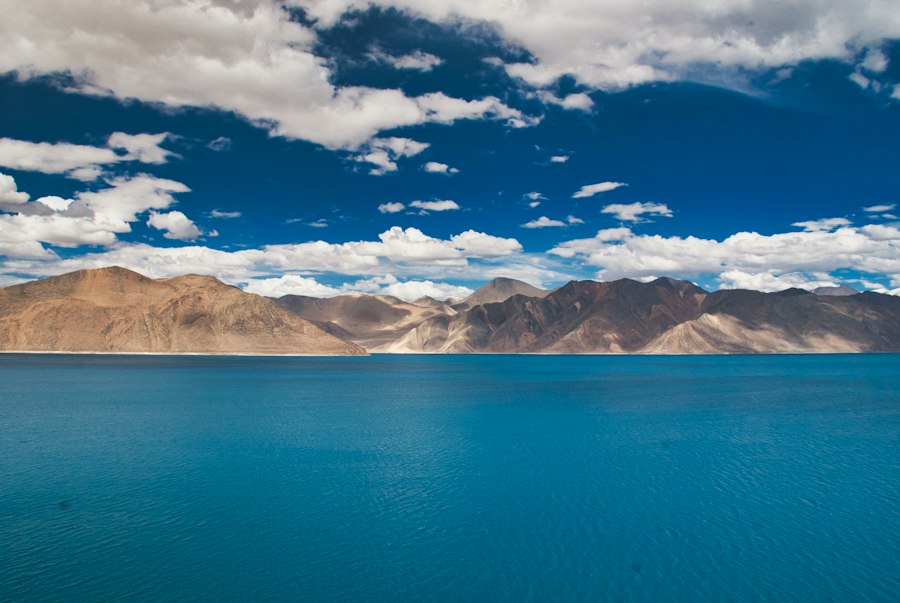
Yes, a Pangong Lake overnight stay is worth it for most travellers from Ahmedabad, on three conditions: you sleep there on day 4 or later of your Ladakh trip, you travel between June and September, and you book a camp with an attached bathroom and oxygen on site. Day-trippers see the lake at midday, when the wind is up and the light is flat. Overnight guests get the still, dark-blue evening, a Milky Way sky, and a sunrise that changes the water from grey to turquoise in about twenty minutes. The trade is one genuinely cold night at roughly 4,225 m, and this guide tells you honestly who should take that trade and who should not.
Where exactly you sleep: Lukung, Spangmik, Man, Merak or Tangtse
"Pangong" on a hotel site usually means one of four shoreline villages on the Indian side of the 134 km lake, or the town of Tangtse before it. Nothing is allowed on the water's edge, so even "lake-view" camps sit about 150–600 m back from the shore.
| Place | Where it is | What you get | Indicative price (Oct 2026 listings) | Best for |
|---|---|---|---|---|
| Lukung | First camps as the road meets the lake | Swiss tents and eco-huts, attached bath, limited evening power | ₹2,800–4,500 per person with dinner and breakfast | Families who want the shortest drive |
| Spangmik | 7 km on, the main camp cluster | 30+ camps, from basic to glamping; some keep oxygen cylinders and power backup | ₹2,500–6,000 per person; top camps up to ₹7,000 | Couples, first-timers, anyone who wants a proper bathroom |
| Man and Merak | 15–25 km further along the shore | Village homestays, shared toilets, home-cooked food, fewer tourists | ₹2,000–2,700 per person with two meals | Budget travellers and photographers |
| Tangtse | 34 km before the lake, about 300 m lower | Guest houses with real rooms, bucket hot water, a few gas heaters | ₹1,500–3,500 per double room | Seniors and anyone who felt the altitude in Leh |
Prices are what camps were listing on booking sites as of October 2026; they vary by date, tent grade and whether you book directly. Camps operate roughly May to early October and most pack up by mid-September to early October, so a late-September "camp" booking can quietly become a homestay. Peak July–August nights sell out; we ask for a confirmed tent 3–4 weeks ahead, not the 2–3 weeks that blogs suggest, because Gujarat's school-holiday departures all want the same dates.
What a night at Pangong actually feels like
This is the part most packages gloss over. The camps sit about 700 m higher than Leh, and there is no heating inside a Swiss tent beyond the quilts. Expect the following, month by month, at night (indicative figures from stargazing and weather guides; the wind off the lake makes it feel 3–5°C colder):
- June: about −2 to −5°C at night, 12–18°C by day. Clear skies, longest days.
- July–August: about −3 to −6°C at night, 15–20°C by day. Warmest water colour, busiest camps, occasional Shyok-road landslides.
- September: about −8 to −12°C at night, 8–14°C by day. Fewer people, golden light, camps start closing after the 15th.
- October: about −12 to −15°C at night. Homestays only, bring your own sleeping bag; not for first-timers.
Most camps run a diesel generator from dusk until about 10:30 PM, then switch it off. That means charging ends, the tent light goes out, and the only sound is wind on canvas. Hot water comes in buckets or flasks, not from a geyser. A mild headache and broken sleep are normal on the first night above 4,000 m even when you are well acclimatised; nausea, confusion or breathlessness at rest are not, and the camp should drive you down to Tangtse immediately. Ask at check-in where the oxygen cylinder is kept and who holds the car keys at night.
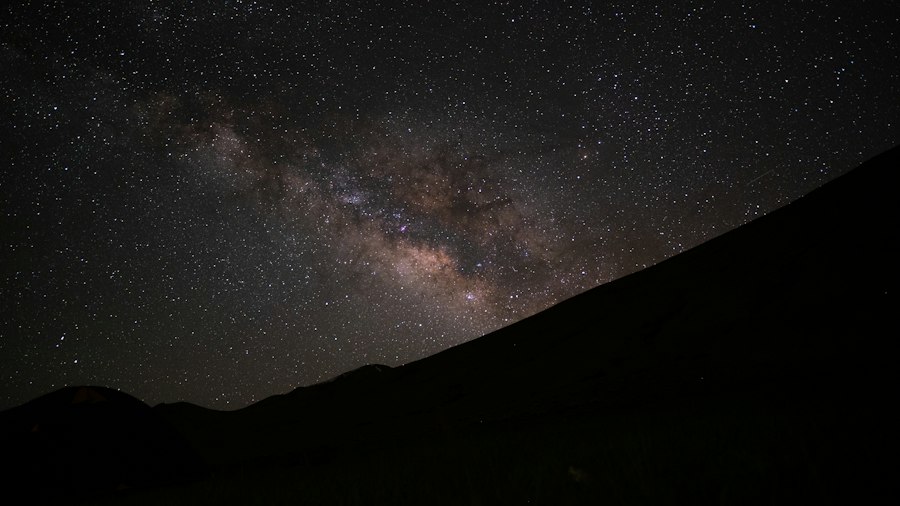
The reward is the sky. The Milky Way core is visible to the naked eye from June to September, best between about 11 PM and 3 AM, and brightest within three days either side of a new moon. If stargazing matters to you, we match the date of your Pangong night to the moon calendar before we book flights.
Camp, homestay, Tangtse or day trip: which one for your group?
Swiss-tent camp at Spangmik or Lukung
Pick this if you want the view and a Western toilet of your own. Choose a camp that lists oxygen cylinders, 24-hour hot water and power backup; the extra ₹1,000–2,000 per person over the basic tents buys exactly those three things. Honeymoon couples should ask for a front-row tent facing the lake and a sunrise wake-up call.
Homestay in Spangmik, Man or Merak
Warmer than a tent (mud-and-stone walls hold heat), cheaper, and the family cooks for you. The cost is a shared squat-or-sit toilet outside the room and no electricity after the solar lamp dies. Good for students and photographers; hard for parents over 60.
A night in Tangtse instead
This is our standard advice for seniors, anyone with blood pressure or heart medication, and families with children under 8. You sleep roughly 300 m lower in a real room, drive 34 km to the lake at dawn, spend two or three hours on the shore, and still reach Leh by evening. In our experience, guests who do this usually sleep better than they did in Leh.
Day trip from Leh
Leave Leh by 5 AM, reach the lake around 10–11 AM via Chang La, leave by 2 PM, back in Leh by 7–8 PM. It is 10 hours in the car for two hours at the water and you cross a 5,360 m pass twice in a day. We suggest it only when a client has a single spare day and is already acclimatised.
Where the night fits in a Ladakh trip from Ahmedabad
Never put Pangong before day 4. From Ahmedabad there is no non-stop flight to Leh; you connect in Delhi, and Leh flights land only in the morning. For early June 2027 the Kiwi.com search showed Ahmedabad–Delhi–Leh return fares of about ₹44,000–45,000 per person with a checked bag as of November 2026, with May and September usually cheaper; prices vary by date. A 6-night plan that handles the altitude properly looks like this:
- Day 0: Evening flight Ahmedabad–Delhi, airport hotel.
- Day 1: Morning flight to Leh (3,500 m). Full rest; no sightseeing, no stairs, 3–4 litres of water.
- Day 2: Sham Valley drive (lower than Leh): Magnetic Hill, Sangam, Alchi. Back to Leh.
- Day 3: Over Khardung La to Nubra. Sleep lower at Hunder (about 3,100 m), camel ride at the dunes.
- Day 4: Nubra to Pangong by the Shyok road, about 175 km and 5–6 hours. Check in at Spangmik by mid-afternoon; sunset on the shore.
- Day 5: Sunrise at the lake, breakfast, then Pangong to Leh via Chang La, about 170 km and 5 hours. Leh market in the evening.
- Day 6: Thiksey and Shey monasteries, Leh Palace, shopping. Fly out on day 7.
If the Shyok road is closed by a landslide (it happens in July–August), you return to Leh from Nubra and do Pangong as a Leh–Pangong–Leh loop on days 5–6 instead; our drivers check the road status the evening before. Every itinerary on our Ladakh tour packages from Ahmedabad page is built around this rest-first order, and the Leh Ladakh packages list shows the 5- to 11-night versions.
Permits, phones, cash and other practical points
Permit. As of October 2026, Indian citizens no longer need a separate Inner Line Permit for Pangong, Nubra or Tso Moriri. You pay the Leh district environment fee on lahdclehpermit.in: ₹400 per person (one-time, valid 21 days) plus a ₹20 per day wildlife fee and an optional ₹50 Red Cross contribution. Carry a printout; most checkposts do not accept a phone screenshot. Foreign passport holders, including NRIs on a foreign passport, need a Protected Area Permit instead, which we arrange separately. Rules have changed several times since 2021, so we reconfirm them for your travel dates.
Mobile network. Jio 4G has reached Spangmik since 2022, and BSNL works patchily; Airtel is weaker beyond Tangtse. Postpaid SIMs are the safe choice in Ladakh, because many travellers report prepaid SIMs from other states not registering on local networks; check with your operator before you fly. Expect no signal at all between Chang La and Tangtse.
Cash. There is no reliable ATM beyond Leh and camps rarely take cards. Carry ₹10,000–15,000 in cash per family for camp extras, the Spangmik tea stalls and tips.
Fuel and vehicle. There is no petrol pump between Karu and the lake. Taxis are from the Leh union; a private Innova or Xylo for the Nubra–Pangong–Leh circuit is priced per circuit, not per day, and we build it into the package so there are no roadside negotiations.
Pure veg and Jain food at Pangong: what to expect and what to carry
Camp dinners are a simple buffet: soup, dal, rice, rotis or puris, one or two sabzis, salad, papad and a sweet. Breakfast is paratha, bread, eggs for those who eat them, and tea. Everything is cooked in a small kitchen tent in batches, so Jain food without onion, garlic and root vegetables is possible only when the camp is told at booking, which we do in writing and reconfirm the day before. Homestays cook Ladakhi staples such as thukpa and skyu; request plain dal-chawal in advance if that suits the family better.
Carry your own thepla, khakhra, mathiya, dry fruit, chikki and a packet of Glucon-D or ORS. Eat light at altitude; a heavy Gujarati thali the night before a 5,000 m pass is a recipe for nausea. Skip alcohol for the whole Pangong leg; it worsens altitude sickness and the cold. Ask for hot water in a flask at night for sips and for brushing; the tap water in the washbasin will be near freezing by morning.
Family, senior and honeymoon notes
- Children: we take families with kids aged 8 and above to the lake for a night, provided the acclimatisation days are followed. Younger children sleep in Tangtse or Leh; the lake is a day visit.
- Parents and seniors: a doctor's check before travel, medicines in hand luggage, and a Tangtse night rather than a tent night. Ground-floor rooms are standard there. If a senior feels fine in Leh and Nubra, a Lukung camp with a heater on request is the compromise.
- Honeymoon couples: book a lake-facing glamping tent in Spangmik, a new-moon date for the stars, and ask the camp for a private sunrise tea on the shore. Pangong is the night couples remember most on a Ladakh trip; it is also the night to have packed properly. Our honeymoon packages team plans the moon date and tent grade before anything else.
- Insurance: a domestic travel insurance plan that covers medical evacuation is worth the small premium here; the nearest hospital is in Leh, five hours away.
What to pack for the one cold night
Pack for the Pangong night separately in a small bag so the main suitcase can stay in the car. You need a down or heavy puffer jacket rated to about −10°C, thermal inners for sleeping, woollen cap, gloves, two pairs of socks, a neck gaiter, lip balm, sunscreen and sunglasses for the daytime glare, a power bank (phone batteries drain fast below zero), a head torch for the night walk to the toilet, a hot-water bottle if a senior is travelling, personal medicines plus the doctor-advised altitude medicine, wet wipes, and a small bag for your own rubbish, because the villages have no waste collection. In September and October add a four-season sleeping bag; camps supply quilts but not at those temperatures.
Pangong vs Tso Moriri: if you can do only one night out
Tso Moriri (about 4,520 m) is quieter, higher, colder and a longer drive from Leh (around 7 hours). Its village, Karzok, has basic guest houses and a couple of camps. For a first Ladakh trip, a family trip or a honeymoon, Pangong wins on comfort, road quality and choice of camps. Tso Moriri suits a second visit, birders and travellers who found Spangmik too busy. Doing both adds two driving days and a Chumathang night; ask us only if you have nine nights or more. If you would rather reach Leh gradually by road over two days from Srinagar instead of flying straight in, that route starts from the trips on our Kashmir tour packages from Ahmedabad page, and Pangong then comes at the very end of the circuit, when you are best acclimatised.
Frequently asked questions
Is it safe to stay overnight at Pangong Lake?
For healthy, acclimatised travellers, yes. The risk is altitude, not the place. Sleep there only on day 4 or later, keep oxygen within reach at the camp, and descend to Tangtse at the first sign of serious altitude sickness. People with uncontrolled heart or lung conditions, pregnant women and small children should not sleep at the lake.
How cold is Pangong Lake at night?
Roughly −2 to −6°C from June to August and −8 to −15°C in September and October, with wind chill on top. Tents have quilts, not heaters, so carry thermals and a warm jacket even in July.
How much does a Pangong camp cost per night?
As of October 2026 listings, roughly ₹2,500–6,000 per person per night with dinner and breakfast for Swiss-tent camps, about ₹2,000–2,700 for homestays and ₹1,500–3,500 per double room in Tangtse. Prices rise in July–August and vary by date and tent grade.
Do we need a permit for Pangong as Indian citizens?
No separate Inner Line Permit as of October 2026, but you must pay the Leh environment fee (₹400 per person plus ₹20 per day wildlife fee) online and carry the printed receipt. Foreign passport holders need a Protected Area Permit.
Will my phone work at Pangong?
Jio 4G works around Spangmik and BSNL is patchy; there is no signal on most of the road from Chang La. Postpaid SIMs are the safer choice in Ladakh. Download offline maps and tell family you will be out of contact for a day.
Can we get Jain food at a Pangong camp?
Yes, if the camp is told at booking. Kitchens are small and cook in batches, so last-minute requests usually get plain dal and rice. We confirm Jain or pure-veg meals in writing with the camp and carry a backup of thepla and khakhra for the group.
Plan your Pangong night with the Ladakh team in Ahmedabad
Vibrant Holidays has planned private Ladakh trips from Ahmedabad for 11 years, with rest-first itineraries, oxygen in every vehicle, confirmed Jain and pure-veg meals, and a camp or Tangtse night chosen for your group. No fixed departures, no group buses.
Call toll-free 1800-313-4262 or visit us on C G Road: 2nd Floor, Ashish Complex, Above Liberty Showroom, Swastik Cross Roads, Ahmedabad – 380009. See all tour packages from Ahmedabad.
