
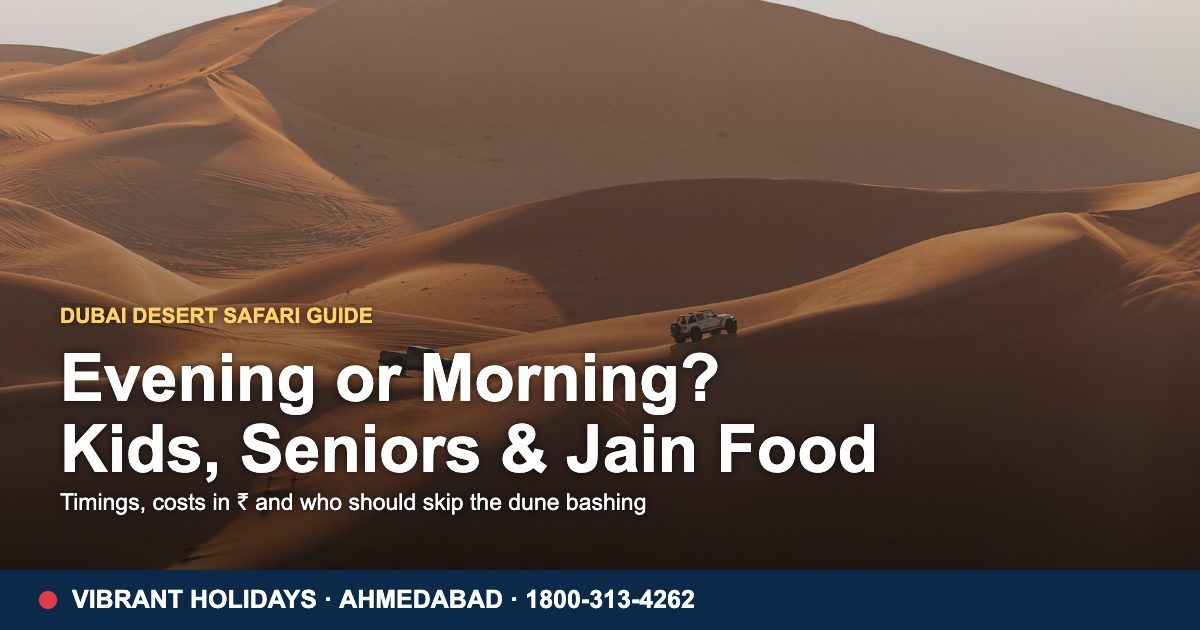
Almost every Dubai itinerary we plan from Ahmedabad has one evening blocked for a desert safari, and almost every family asks the same three questions before it: is the dune bashing safe for Dadi and the toddler, evening or morning, and will there be proper veg food at the camp? This Dubai desert safari guide answers all three with real timings and costs, so you can pick the right version for your group instead of the one the hotel desk sells first.
The five kinds of desert safari, side by side
"Desert safari" covers five quite different products. Indicative shared-basis prices below are as of November 2026, converted at roughly ₹25.6 per AED; they rise 15–25% in the November–March peak and vary by operator and date.
| Type | Timing | Indicative cost per person | Best for |
|---|---|---|---|
| Standard evening safari (shared 4×4) | Pick-up 3–3.30 pm, back 9–9.30 pm | AED 130–250 (₹3,300–6,400); quad-bike or VIP-camp versions AED 400–500 | First-timers, families with children 5+, budget trips |
| Private 4×4 evening safari | Same as above, your own vehicle | AED 750–1,200 per vehicle for up to 6 (₹19,000–31,000) | Joint families, anyone who wants to set the pace of the dune drive |
| Morning safari | Pick-up 8–10 am, about 4 hours | AED 100–110 shared (₹2,600–2,800); AED 290 with quad bike | Short trips, late-evening flight days, people who skip dinner shows |
| Overnight safari | 3 pm pick-up, back next morning | AED 350–720 (₹9,000–18,500) | Honeymooners, stargazers, no young children |
| Conservation-reserve heritage safari (no dune bashing) | Pick-up 2.30–4.30 pm, 7 hours | About AED 3,980 for two on a private basis (₹1,02,000 per couple) | Senior parents, anniversaries, luxury travellers |
What actually happens on a standard evening safari
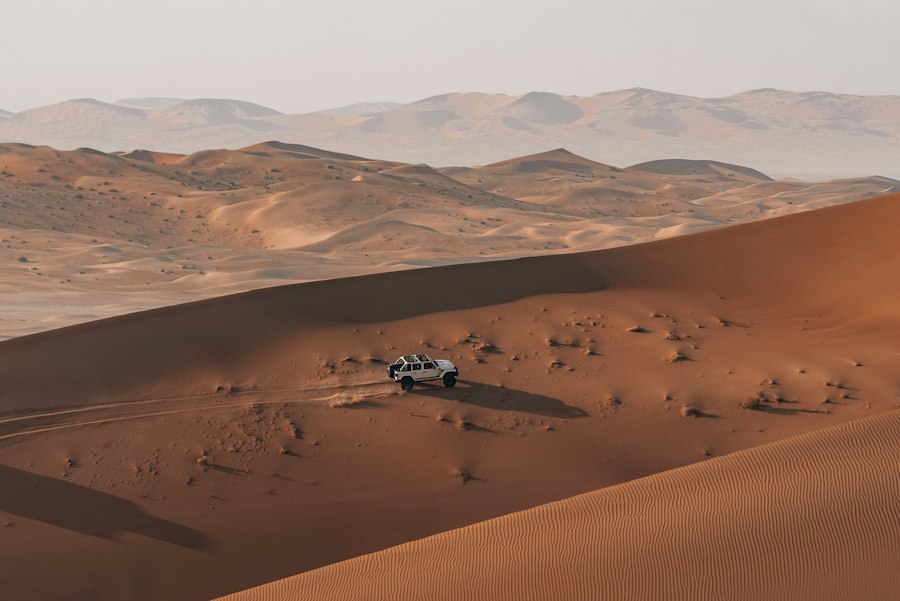
The 4×4 collects you from the hotel around 3 pm and drives 45–60 minutes to the Lahbab or Al Awir red dunes east of the city. Tyres are deflated at a roadside stop, then comes 20–30 minutes of dune bashing: the driver climbs and slides across the dunes in a controlled drift. A sunset photo stop follows, usually with sandboards and a few camels, and you reach the camp around 6 pm. Sunset in Dubai is about 5.30 pm in December and 5.50 pm in mid-January, so a winter safari is timed well; in May the sun sets near 7 pm and the dune drive runs in real heat.
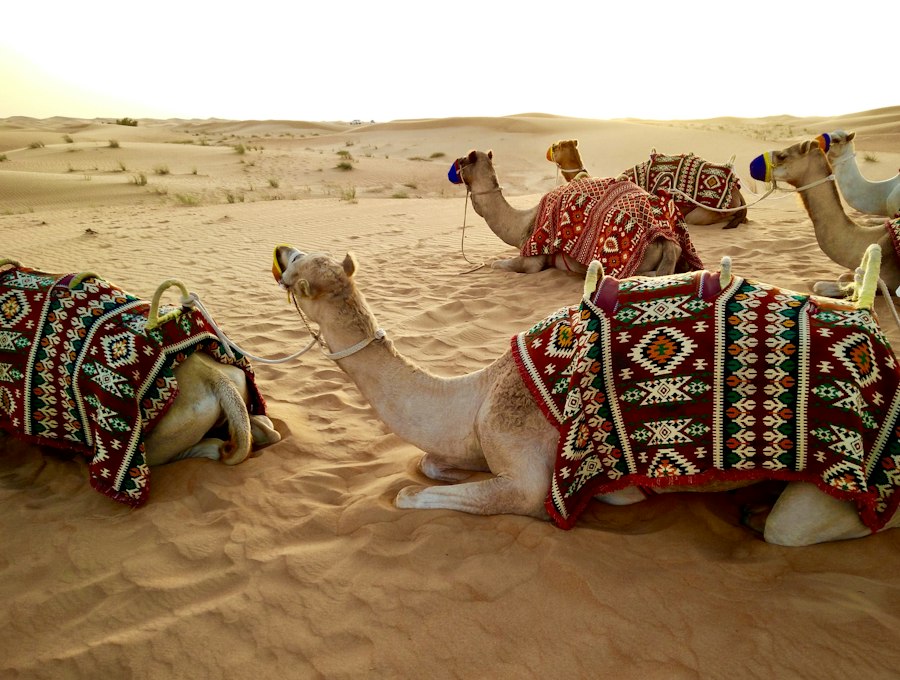
At the camp you get a short camel ride, henna, Arabic costume photos, unlimited soft drinks and tea, and a barbecue buffet dinner with a separate vegetarian counter. Shows start after dark: tanoura (the spinning dance), a fire show and, at most camps, belly dance. Expect to be back at the hotel by 9.30 pm. The whole evening is 6–7 hours, which is why we never put a safari on arrival day for a family flying in on the early-morning Air Arabia or FlyDubai departures from Ahmedabad.
Evening vs morning: how to choose
Pick the evening safari if it is your first Dubai trip, you have children of five or older, or you want the full camp-dinner-show experience. Pick the morning safari if your trip is three nights or shorter and the evenings are already spoken for (Burj Khalifa at sunset, dhow cruise, Global Village), if you have an evening flight home and want the desert on the last day, or if your parents would rather be back at the hotel for lunch than sit outdoors till 9.30 pm. The morning version has the same dune bashing and camel ride but no camp dinner, so it costs less than half and finishes before the heat builds. It is also the better choice in April–May, when the evening camp is still warm at 7 pm.
The overnight safari is the evening programme plus a Bedouin tent, a sunrise walk and breakfast. In December and January the desert drops to 12–15°C at night, so carry a jacket. We suggest it for couples and friends' groups rather than families with small children, because toilets are basic and there is nothing for a bored child to do after the shows end.
The premium option: a safari without dune bashing
A different product sits inside the Dubai Desert Conservation Reserve, the protected area that takes up roughly five percent of the emirate. Operators such as Platinum Heritage run it in open-top vintage Land Rovers at walking pace, looking for Arabian oryx and gazelle, followed by a falcon show at sunset and a torch-lit camp with a served dinner instead of a buffet. There is no dune bashing at all, pregnant guests are accepted until the second trimester, and vegetarian meals are available on request. At about AED 3,980 for two on a private basis (as of November 2026) it is the most expensive safari in this guide, but for a 70-year-old parent, a 25th anniversary or anyone who wants the desert quiet, it is the one we book.
Dune bashing: who should skip it and how to make it gentler
Dubai has no government rule fixing a minimum age for dune bashing; operators set their own, and some still accept infants. After a three-year-old died in a 4×4 rollover in 2018, Gulf News reported operators themselves advising that no child under three should go on the dune drive and that everyone must be belted. Our rule for Ahmedabad families is stricter: under-fives, anyone pregnant, and anyone with a back, neck or heart condition or recent surgery sit the dune bashing out. Each of them can still enjoy the full camp.
There are three ways to do that. First, ask for a "direct camp transfer": the vehicle drives you to the camp on the road while the rest of the family does the dunes, and you meet at the sunset point. Second, book a private 4×4 and tell the driver "soft drive"; a good driver will keep to the smaller dunes and stop the moment anyone looks unwell. Third, choose the conservation-reserve safari above, which has no dune drive by design. For everyone else: eat a light lunch, sit in the front or middle row rather than the last, keep the seatbelt on (the driver will check), and keep phones in a zipped pocket, because loose items fly.
With kids: what works at each age
Children under three ride to the camp directly and love the camels, the henna and the fire show, but will be asleep by 8 pm, so sit near the exit. Ages three to five can do the camp but we still keep them off the dunes. From about five or six upwards, most children ask to do the dune bashing again. Quad bikes and dune buggies are paid extras (roughly AED 150 for 30 minutes on a quad, as of November 2026) and operators set their own minimum ages and height rules, so ask before promising a ride. Child seats are not provided in shared vehicles; a private 4×4 lets you fit your own. Carry a light jacket for December evenings, wet wipes for sandy hands before dinner, and a few snacks, because dinner is served after 7.30 pm.
If you are planning the whole trip around children, our Dubai with kids five-day family plan shows where the safari fits between the theme parks and the Abu Dhabi day.
With senior parents: comfort first
A standard camp means floor seating on cushions around low tables, sand underfoot, portable toilets and a 45-minute drive each way. For parents in their seventies we either book a VIP or premium camp (proper chairs and tables, cleaner toilets, a quieter corner, served food), the private 4×4 with a soft drive or direct transfer, or the conservation-reserve safari. Tell us about knee problems in advance: the camel ride involves a sharp lurch when the camel stands, and it is fine to skip it. Our guide to travelling with senior citizen parents covers the wheelchair request at the airport and the medical paperwork worth carrying.
Veg and Jain food at the camp
Every mainstream camp runs a vegetarian counter: usually dal, a paneer dish, rice, salads, hummus with bread, and a grilled-vegetable station, plus dessert. It is pure veg in the sense that it is cooked separately from the meat barbecue, but it is not Jain by default: onion and garlic are in most of it. For Jain families we pre-book a Jain meal with the operator at the time of booking, not on the day, and we confirm it in writing. Several Indian-run camps do this routinely in the winter season. If you are strict, carry theplas and dry snacks as a backup; the buffet opens after sunset and the children will be hungry before that. Our Jain food in Dubai guide lists the Karama and Bur Dubai thali houses for the other evenings.
What it costs from Ahmedabad
If you book a package, the standard evening safari with dinner is normally included; the private 4×4, quad bike, VIP camp and conservation-reserve safari are upgrades we price separately. Booked on its own, budget AED 130–250 per person for the shared evening safari and AED 100–110 for the morning version (as of November 2026). Online rates are typically 10–20% below the hotel-desk price.
Flights are the larger number. Non-stop Ahmedabad–Dubai return fares for two adults with check-in bags were from about ₹86,600 for 18–23 December 2026 (Air Arabia to Sharjah out, SpiceJet back) and from about ₹76,600 for 22–27 January 2027 (SpiceJet out, IndiGo back) when we checked on 8 November 2026; that is roughly ₹38,000–43,000 per person and it changes daily. Emirates and FlyDubai on the same dates were ₹1,01,000–1,15,000 for two. See the current price bands on our Dubai tour packages page, and remember the Dubai visa for Indians is a separate cost; we assist with the application but approval is always the UAE's decision. Carry a small amount of AED cash for tips and the quad bike: our forex desk loads a card before you fly, and a travel insurance policy that covers adventure activities is worth checking before anyone gets on a quad.
Best months and the Ramadan note
November to March is the season: 18–28°C by day and cool enough at the camp to enjoy the fire show. April and October are warm but workable, especially on the morning safari. From June to September the evening camp is 38°C at 6 pm and the shows feel like an endurance test; if a summer trip is fixed, take the morning safari at 8 am and keep the evening for a mall. Ramadan 2027 is expected to run from 8 February to about 9 March (UAE astronomers' projection as of October 2026). Safaris run throughout, but live music and dance shows are usually skipped and the camp serves dinner after sunset only, so a Ramadan evening safari is quieter than the usual one.
What to wear and carry
Loose cotton, closed shoes or sandals you do not mind filling with sand, sunglasses and a cap for the sunset stop, and a light jacket from December to February. Carry a power bank (the camp has no charging), a small bottle of water for the drive, and motion-sickness tablets for anyone who gets car-sick on the Ahmedabad–Mount Abu ghats; the dune drive is harder than that. Leave jewellery and anything loose at the hotel.
Where the safari fits in a five-day trip
- Day 1: Arrive, hotel check-in, evening at Dubai Mall and the fountain. No safari on arrival day.
- Day 2: City tour in the morning, rest after lunch, evening desert safari with pick-up at 3 pm.
- Day 3: Abu Dhabi day trip, which is a full day with an early start.
- Day 4: Theme park or Global Village; if anyone skipped the dunes on Day 2 and wants a second go, the morning safari fits here.
- Day 5: Burj Khalifa in the morning, shopping, late flight home.
FAQ
Is a desert safari safe for a three-year-old?
The camp, camel ride and dinner are fine for all ages. We keep children under five off the dune bashing and book a direct camp transfer for them and one adult instead. Dubai has no legal minimum age, so it is your call, but belts are non-negotiable.
Evening or morning safari for first-timers?
Evening. The camp, the sunset and the shows are most of the experience; the morning version is the same dune drive without them.
Can pregnant women go on the safari?
Not on the dune bashing. Operators will usually drive you to the camp directly, and the conservation-reserve safari accepts pregnant guests until the second trimester because it has no dune drive. Check with your doctor first.
How much does a Dubai desert safari cost in rupees?
About ₹3,300–6,400 per person for a shared evening safari with dinner and ₹2,600–2,800 for the morning safari, as of November 2026. A private 4×4 is ₹19,000–31,000 per vehicle, and the premium conservation-reserve safari about ₹1,02,000 per couple. Prices vary by season and operator.
Will there be Jain food?
Only if it is booked in advance. The standard veg buffet contains onion and garlic; we pre-order Jain meals with the operator in writing and suggest carrying dry snacks as a backup.
Is the dune bashing included in every safari?
In the standard evening, morning and overnight safaris, yes, but you can ask to skip it. The conservation-reserve heritage safari has no dune bashing at all.
Plan your Dubai safari with us
Vibrant Holidays has planned private, customised Dubai trips from Ahmedabad for 11 years, with Jain meals pre-booked at the camp and the right safari matched to every age in the family. Call toll-free 1800-313-4262 or visit us at 2nd Floor, Ashish Complex, Above Liberty Showroom, Swastik Cross Roads, C G Road, Ahmedabad – 380009. See all tour packages from Ahmedabad at www.vibrant.holiday.
