
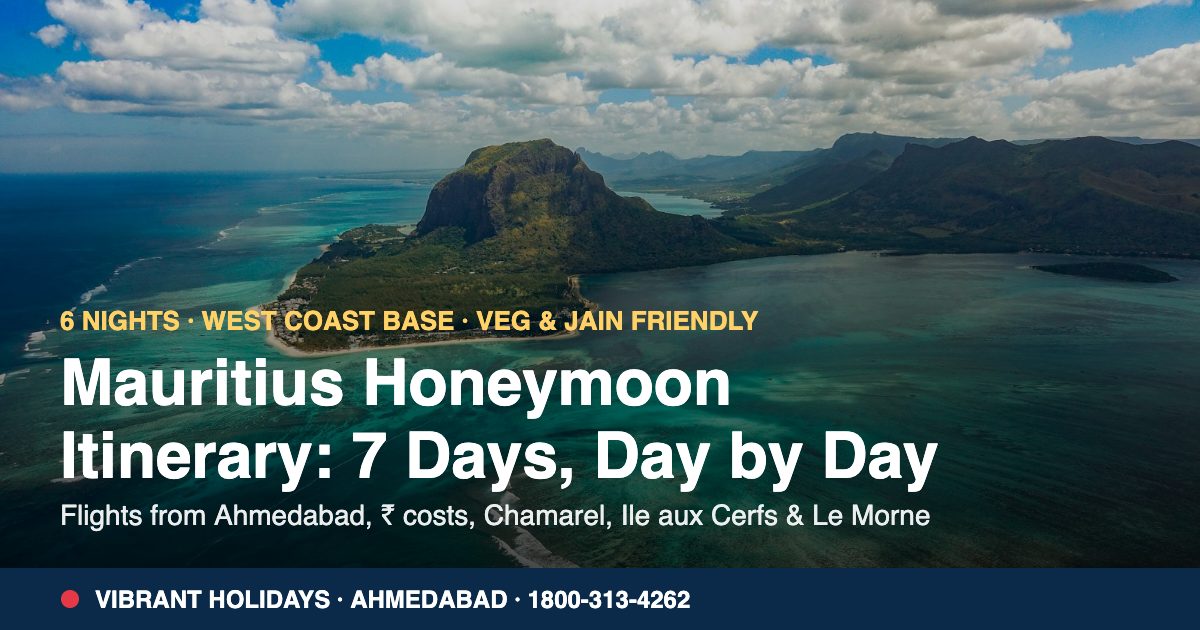
Most couples we plan Mauritius for have the same two questions: "Which side of the island should we stay on?" and "What do we actually do for seven days?" This Mauritius honeymoon itinerary for 7 days (6 nights) answers both. It is the plan we most often build for couples flying out of Ahmedabad after a winter wedding: one west-coast base, two big sightseeing days, one boat day, and enough empty afternoons that the trip still feels like a honeymoon and not a tour. Costs are in rupees, food notes assume you eat pure veg or Jain, and the flight times are real ones from Ahmedabad as of November 2026.
Before you book: four decisions that shape the week
1. Six nights is the sweet spot
Mauritius is small (about 65 km north to south) but the roads are slow, and a full day out means 7–9 hours away from the pool. Four nights feels rushed once you subtract the arrival morning and departure day. Eight nights starts to repeat itself unless you add Rodrigues or a second coast. Six nights gives you three outing days, two lazy days and no guilt.
2. Stay on the west coast (and why not the north or east)
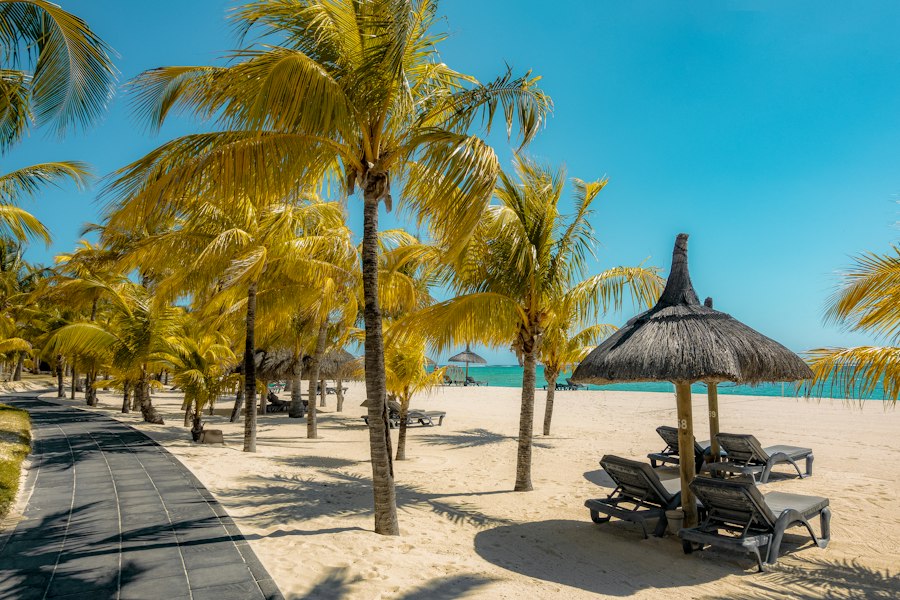
For a honeymoon we almost always book the west coast: Flic en Flac, Wolmar, Tamarin or Le Morne. Sunsets face the sea, the lagoon is swimmable all year, Chamarel and Black River Gorges are 30–40 minutes away, and the Tamarin dolphin boats leave from your doorstep. The north (Trou aux Biches, Grand Baie) is livelier, has the most Indian restaurants and is better for families or for couples who want to walk out to shops and cafés in the evening. The east (Belle Mare) has the longest beaches and is closest to Ile aux Cerfs, but it is windy from June to September and quiet after dark. If you want both moods, split 3 nights west + 3 nights north; just remember every hotel change eats half a day.
3. Half board, not all-inclusive
All-inclusive plans in Mauritius are priced around unlimited alcohol and à-la-carte seafood. A vegetarian couple rarely gets the value back. Half board (breakfast + dinner) is what we recommend: you are out at lunchtime on sightseeing days anyway, and the resort buffet dinners reliably have dal, sabzi, rice, rotis and a salad counter. Ask us to request a Jain meal plan at booking; the good resorts prepare no-onion, no-garlic dishes if told a few days ahead, not on the night.
4. Carry your marriage certificate
Most Mauritian resorts give honeymoon benefits (room upgrade on availability, a decorated room, a cake or a sparkling-wine substitute, sometimes a free dinner) to couples married within the last 6–12 months. The window differs by hotel, and the benefit must be written into the booking confirmation; a verbal "we will see at check-in" usually becomes nothing. Keep a photo of the certificate on your phone.
Getting there from Ahmedabad
There is no non-stop flight from Ahmedabad to Mauritius. The two routings we use most:
- Via Mumbai on Air India: an evening Ahmedabad–Mumbai hop, then AI2241 leaving Mumbai around 02:00 and landing in Mauritius at about 06:55 local time. Coming back, AI2242 departs Mauritius at 09:00 and you are home in Ahmedabad by about 22:30 the same night.
- Via Bengaluru on IndiGo: a late-night Ahmedabad–Bengaluru flight connecting to 6E1861, which departs around 04:05 and lands in Mauritius at about 08:30. The return 6E1862 leaves at 09:30.
As of 3 November 2026, a return ticket for two adults with checked bags on either routing in the first half of December 2026 was showing from about ₹1,45,000 for the couple (roughly ₹72,000 per person). Fares move with the date; Christmas–New Year and mid-May run higher, late April and September lower. Book both legs on one ticket so bags are checked through and a delay on the first flight is the airline's problem, not yours. Mauritius is 1½ hours behind India, so the morning arrival feels like a very early start; plan nothing for day one.
Entry rules for Indian passport holders
As of November 2026, Indian tourists do not need a visa in advance: immigration issues a tourist entry at the airport, normally for up to 60 days. Carry a passport valid for at least six months beyond your return, your return ticket, the hotel confirmation and a card or some forex as proof of funds. Mauritius also asks every arriving passenger to fill the free All-in-One Travel Digital Form online before check-in (most airlines want it done within 72 hours of arrival); keep the QR code on your phone. Entry is always at the officer's discretion and rules can change, so we re-check them with you a week before departure.
The 7-day Mauritius honeymoon itinerary, day by day
This assumes a west-coast resort and arrival on the morning Air India or IndiGo flight. Swap days 2 and 5 if your hotel is in the north.
Day 1 – Arrive, breathe, sunset
Landing between 07:00 and 08:30, you clear immigration and are at a west-coast hotel by about 10:00 (the airport is in the south-east; the drive is 45–60 minutes). Standard check-in is 14:00; ask us to request early check-in, but do not count on it in peak weeks. Leave bags, have breakfast if the hotel allows it, and sleep two hours by the pool. In the evening, walk the public beach at Flic en Flac (the sunset is at about 18:45 in December) and eat in the hotel. No excursions today.
Day 2 – The south-west loop: Chamarel, Black River Gorges and Ganga Talao
Leave at 08:30 with a private car and driver. First stop is Chamarel Seven Coloured Earth Geopark (non-resident entry Rs 800 per adult as of November 2026, about ₹1,600; opens 08:30). The ticket covers the two Chamarel waterfall viewpoints, the coloured dunes and the giant tortoise enclosure; go early and the light on the dunes is at its best. Continue up to the Black River Gorges viewpoint and Alexandra Falls (free), then to Ganga Talao (Grand Bassin), the crater lake with the Shiva temple and the 33-metre Shiva statue that most Gujarati couples want to visit on the first sightseeing day; dress modestly, remove shoes at the temple, and there is a free vegetarian prasad hall on busy days. Loop back through Curepipe to look into the Trou aux Cerfs crater. Lunch: ask the driver for a Chamarel restaurant that serves a vegetarian "table d'hôte", or carry the Jain lunch box the resort packed. Back by 16:30 for the pool.
Day 3 – Ile aux Cerfs catamaran day
The classic Mauritius boat day. Full-day catamarans leave the east coast (Trou d'Eau Douce or Pointe Jérôme) at about 09:00 and return by 16:00, sailing past the Grand River South East waterfall, stopping to snorkel, then anchoring at Ile aux Cerfs for two or three hours of lagoon, sandbar and beach. Shared catamarans cost about €70 per adult as of November 2026 (roughly ₹7,500) including a grilled lunch and unlimited drinks; tell the operator in advance that you are vegetarian or the lunch will be chicken and fish with salads. From the west coast the transfer is 75–90 minutes each way, which is why many couples do this day on an east-coast or north-coast hotel in a split stay. If you would rather skip the shared boat, a private speedboat from the west coast to Ile aux Bénitiers and Crystal Rock (near Le Morne) is a shorter, quieter alternative.
Day 4 – Dolphins at dawn, then nothing
Tamarin Bay's spinner and bottlenose dolphins are seen in the early morning; boats leave around 06:30 and are back by 09:00, so you are at breakfast by the time the rest of the hotel wakes up. Trips cost in the ₹3,000–6,000 per person band depending on boat size and whether swimming is included (prices vary by operator). The rest of the day is deliberately empty: couple's spa, kayak in the lagoon, or the hotel's free glass-bottom boat. This is the evening to book the candle-lit beach dinner; resorts charge roughly Rs 5,000–12,000 per couple for the set-up and a vegetarian set menu can be arranged if asked two days ahead.
Day 5 – The north: Port Louis, Pamplemousses and Cap Malheureux
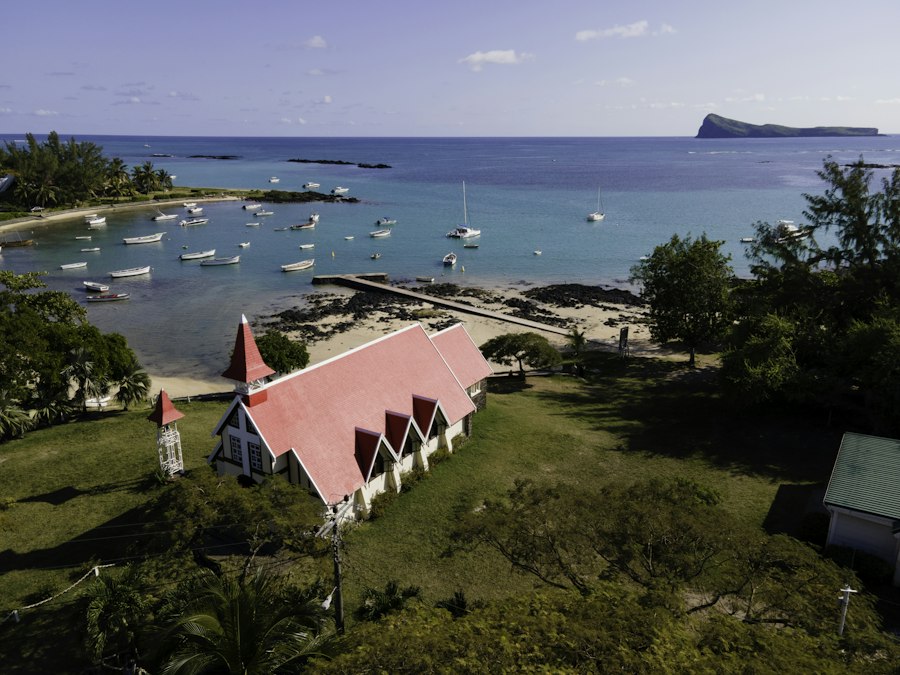
Second long day. Start in Port Louis (45 minutes from Flic en Flac): the Caudan Waterfront, the Central Market for vanilla tea, spices and dholl puri, and the Aapravasi Ghat, the UNESCO immigration depot where indentured workers from India first landed in 1834; for most Indian visitors it is the most moving half hour of the trip. Drive to the Sir Seewoosagur Ramgoolam Botanical Garden at Pamplemousses for the giant Amazon water lilies, then north to the red-roofed church at Cap Malheureux with Coin de Mire island behind it, and finish with an evening in Grand Baie, where the pure-veg Indian restaurants are.
Day 6 – Choose your big experience, then sunset at Le Morne
Keep one paid highlight for the last full day so there is something to look forward to. Options, all indicative as of November 2026: the Blue Safari submarine at Trou aux Biches (about US$170 per person, roughly ₹15,000, a 45-minute dive to 35 metres; not for anyone with heart problems), the undersea walk with a helmet in the north (in the ₹3,000–5,000 band, no swimming needed), or Casela Nature Parks on the west coast (entry roughly Rs 800–1,900 depending on season and offer; safari truck, giraffes, big cats). Casela is a 15-minute drive from Flic en Flac and the easiest of the three to fit in. Be at Le Morne public beach by 17:30 for the final sunset under the mountain.
Day 7 – Fly home
Both the Air India and IndiGo return flights leave between 09:00 and 09:30, so you need to leave the west coast by about 06:15. Ask the hotel for a packed breakfast the night before and settle extras after dinner on day 6 to avoid a 06:00 queue at reception. You are home in Ahmedabad the same night.
What the week costs: an honest ₹ breakdown
All figures are indicative, per couple, as of November 2026, and vary by travel date and hotel. We quote exact numbers only against a real date.
| Item (6 nights, 2 adults) | Indicative cost | Notes |
|---|---|---|
| Flights Ahmedabad–Mauritius return, 1 stop, checked bags | from ₹1,45,000 | Early Dec 2026 fare seen 3 Nov 2026; higher at Christmas and in May |
| Hotel, half board, 6 nights | ₹75,000–1,00,000 (3-star) · ₹1,30,000–2,00,000 (4-star) · ₹2,50,000+ (5-star) | West-coast sea-facing rooms sit at the top of each band |
| Airport transfers + 3 private car days | ₹25,000–35,000 | A car with driver runs about Rs 3,500–5,500 per 8–9 hour day |
| Chamarel + catamaran + dolphins | ₹25,000–32,000 | Rs 800 pp, about €70 pp, and ₹3,000–6,000 pp respectively |
| Day-6 highlight (Casela / undersea walk / submarine) | ₹4,000–30,000 | Casela cheapest, submarine most expensive |
| Lunches, beach dinner, tips, SIM | ₹20,000–35,000 | Veg lunches Rs 400–900 pp outside the resort; 1 MUR ≈ ₹2.03 in Nov 2026 |
| Realistic total for two | about ₹3,00,000–3,40,000 at 3-star, ₹3,60,000–4,40,000 at 4-star | Excludes shopping and travel insurance |
Two ways couples overspend: paying for all-inclusive they do not drink, and booking every excursion through the hotel desk at 20–30% above the operator's own price. Two ways they save badly: a cheap "room only" guesthouse far from the beach, and flying in on separate tickets to shave ₹5,000.
Best months for a Mauritius honeymoon from Gujarat
Mauritius is in the southern hemisphere, so its seasons are the reverse of ours. November to mid-December is our favourite honeymoon window: 25–30°C, calm lagoons, long days, prices still below the Christmas peak. Late December to early January is the busiest and most expensive fortnight of the year. January to March is hot, humid and the cyclone season; a cyclone warning does not mean disaster (resorts are built for it) but it can cost you two days indoors, so couples marrying in January or February often go in April instead. April–May and September–October are the value months with good weather. June–August is cooler (18–24°C) and windy on the east and south; fine on the west coast, but not swimsuit weather every day.
Pure veg and Jain food: what actually works
About two-thirds of Mauritians trace their roots to India, so vegetarian food is normal, not a special request. Street food to try: dholl puri (a soft split-pea flatbread with bean curry and chutney; confirm the curry is veg, as some stalls add fish), gateau piment (chilli lentil fritters) and alouda (a basil-seed milk drink). Grand Baie, Flic en Flac and Quatre Bornes have pure-vegetarian Indian restaurants; your driver will know the current ones. Resort buffets manage dal-rice-roti every night; the gap is lunch on excursion days, which is why we ask the hotel for packed Jain lunch boxes. Carry theplas, khakhra and a small pack of masala for emergencies; sealed dry snacks are allowed in. Shared catamarans are alcohol-heavy; it is perfectly normal to skip the drinks and ask for extra juice.
Five mistakes we see honeymooners make
- Booking an east-coast hotel in July because it was cheap, then finding the beach too windy to use.
- Planning Chamarel and Ile aux Cerfs on consecutive days from the west coast; that is 11 hours in a car across two days. Put a rest day between them.
- Expecting the honeymoon upgrade without the certificate, or with a wedding older than the hotel's window.
- Carrying only US dollars; Mauritian rupees are what the market, taxis and small restaurants want, and the airport counters give poor rates. Change a small amount in Ahmedabad and use the hotel ATM.
- Skipping travel insurance on a trip where a single cyclone-day flight change can cost more than the policy.
How we build this trip for you
Every Mauritius trip we plan is private and customised: no group, no fixed departure, no tour manager. Tell us your wedding date, budget band and whether you are veg or Jain, and we send a day-by-day plan with the real hotel names and current fares. See the current Mauritius tour packages from Ahmedabad for prices by hotel category, browse our honeymoon packages for other islands, or read Maldives vs Bali for a honeymoon if you are still choosing. Our island honeymoon packing list applies to Mauritius almost line for line, and we can arrange forex in Mauritian rupees before you fly.
Call Vibrant Holidays toll-free on 1800-313-4262 or visit us at 2nd Floor, Ashish Complex, Above Liberty Showroom, Swastik Cross Roads, C G Road, Ahmedabad – 380009. Since 2015, 11 years of planning honeymoons for Gujarat's couples.
FAQ: Mauritius honeymoon itinerary
Is 7 days enough for a Mauritius honeymoon?
Yes. Six nights and seven days covers the south-west, the north, one boat day and two rest days without rushing. Go to eight nights only if you want to split your stay between two coasts or add Rodrigues.
Which part of Mauritius is best for honeymooners?
The west coast (Flic en Flac to Le Morne) for sunsets, calm water and short drives to Chamarel; Le Morne itself for luxury resorts. The north suits couples who want restaurants and shopping within walking distance.
How much does a 7-day Mauritius honeymoon cost from Ahmedabad?
Indicatively ₹3–3.4 lakh for two at 3-star level and ₹3.6–4.4 lakh at 4-star, including flights, half-board hotel, transfers and the main excursions, as of November 2026. Dates and hotel choice move it either way.
Do Indians need a visa for Mauritius?
As of November 2026, no advance visa: Indian passport holders receive a tourist entry at the airport, usually for up to 60 days, after showing a return ticket, hotel booking and proof of funds. Fill the free online travel form before check-in. Entry remains at the officer's discretion, and rules can change.
Is Jain food available in Mauritius?
Yes, with notice. Resorts prepare no-onion, no-garlic meals when the request is in the booking, and pure-veg Indian restaurants exist in Grand Baie, Flic en Flac and Quatre Bornes. Ask for packed lunch boxes on excursion days.
What is the best month for a honeymoon in Mauritius?
November to mid-December for the best mix of weather and price; April–May and September–October for value. Late December is the peak, and January to March carries cyclone risk.
